
Performance Results
The heating cycle of ELIK's intelligent, high-efficiency billet furnace measurably enhances the mechanical properties of the extruded profile, delivering a metallurgical outcome comparable to a dedicated homogenizing treatment.
- The actual billet temperature is precisely controlled throughout the cycle.
- The PLC touchscreen control is fully automated and has the ability to record and recognise the heating time, temperature, and billet alloy. It can also select the billet.
- From the infeed and discharge of the billet to the opening of the extrusion press feed, the operation is entirely automated.
Metallurgical result: homogenisation by heating
The furnace was tested on two common extrusion alloys, 6063 and 6463, comparing microstructure at three different stages: as-cast, after solo homogenizing treatment, and after heating in the ELIK intelligent energy-saving billet furnace.
Both alloys' as-cast billets contain thick grain boundaries and significant intragranular dendrites. Heating causes them to dissolve into the α-Al matrix, resulting in smaller and more discontinuous grain boundaries and fewer intragranular dendrites. As a result, the furnace's heating cycle produces a homogenizing effect, which refines the cast structure during the heating step.
(Metallographic photos of 6063 and 6463 at various stages are provided on the page.)
| 6063 Alloy | 6463 Alloy | |
| As-cast structure | 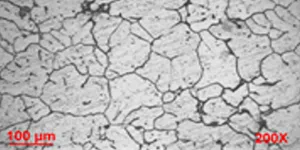 | 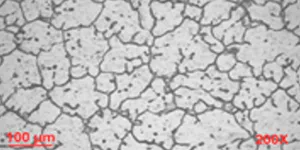 |
| After dedicated homogenization | 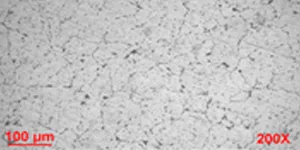 | 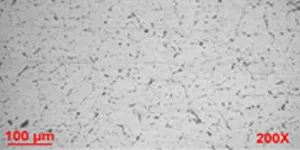 |
| After ELIK billet-furnace heating | 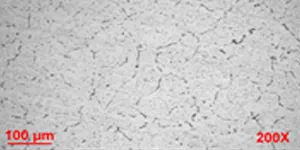 | 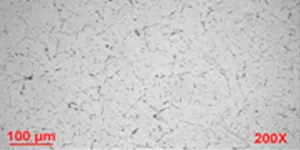 |
Mechanical characteristics after refining
The properties of profiles produced from furnace-heated billets are significantly superior to those of the Chinese national standard GB/T6892-2006, as evidenced by tensile testing:
| Alloy/temper | Tensile strength σb (MPa) | Yield strength σ0.2 (MPa) | Elongation δ (%) |
| 6463-T5 - National standard GB/T6892-2006 | 150 | 110 | 6 |
| 6463-T5 - ELIK furnace | 295 | 261 | 11 |
| 6063-T8 - ELIK furnace | 305 | 270 | 9 |
The minimum tensile and yield strength of the standard are nearly doubled by the furnace-heated material for 6463-T5, and the elongation requirement is also surpassed. This results in an improvement in both strength and ductility, rather than a trade-off.